The New Macroeconomic Paradigm: Navigating Japan’s Supply-Constrained Frontier


The Ministry of Economy, Trade and Industry (METI) has published "The 5th Interim Report of the Subcommittee on New Economic and Industrial Policy, Council for the Industrial Structure", outlining a comprehensive Japanese economic strategy for 2026, focusing on industrial restructuring and sustainable growth.
METI aims to address domestic labor shortages and capital constraints through strategic investment in AI, robotics, and green transformation. To maintain global relevance, METI identifies five distinct winning patterns for Japanese firms, emphasizing the transition from simple manufacturing to high-value, data-driven service models. It also stresses the importance of economic security and supply chain resilience amidst rising geopolitical tensions and fluctuating energy prices.
Ultimately, the framework seeks to bridge the gap between industrial innovation and consumer revitalization to foster a robust economic cycle.
1. The Structural Reality of a Supply-Constrained Economy
Japan has reached a critical decision point, marked by the end of the demand-deficient, deflationary era that characterized the "lost decades." Japan has transitioned into a supply-constrained environment where the output gap has turned positive. This represents a fundamental shift in Japan’s economic DNA; the primary bottleneck to growth is no longer a lack of demand, but a structural deficit in productive capacity. With nominal GDP surpassing 660 trillion yen—a record high—the priority must shift from stimulating consumption to expanding the supply frontier. However, this domestic reality is complicated by external supply shocks, specifically the heightened volatility in the Middle East and its impact on oil prices, which underscores the fragility of Japan's resource-dependent economy.
Evaluation of the Labor-Capital Gap
The current supply-demand gap is defined by a dual constraint that threatens to stall Japan's momentum:
- Structural Labor Scarcity: This is a "structural labor shortage" where the relative decrease in the working-age population has created an absolute lack of human resources in critical nodes.
- Capital Investment Constraints: While the appetite for investment is high, the "Employment DI" (Diffusion Index) for construction and production equipment is extremely tight. This creates a paradoxical bottleneck: the very capital investments required to solve labor shortages—such as DX (Digital Transformation) and GX (Green Transformation)—are themselves being delayed because the human and physical capital needed to install them is unavailable.
The critical risk is "investment-induced supply shocks." If Japan attempts to execute growth strategies without first resolving these constraints, the lack of human and physical capital will drive inflation without growth, leading to stagnation. Because private investment alone cannot bridge these gaps under such tight conditions, Japan requires a radical redefinition of the state’s fiscal role—moving from "stimulus" to "strategic de-risking."
2. Fiscal Policy as a "Total National Strategy Tool"
In this new paradigm, fiscal policy must evolve into "Policy Mix 2.0," a comprehensive instrument for national survival and industrial sovereignty. Japan must transition toward "Responsible Active Fiscal Policy," which distinguishes itself from traditional Keynesian spending by focusing on "Socially High-Return National Investment."
The Economics of r vs. g
The sustainability of Japan’s debt is predicated on the relationship between the interest rate (r) and the growth rate (g). By ensuring g > r through high-productivity investments, Japan can maintain fiscal integrity while funding the massive transitions required for the 2040 horizon.
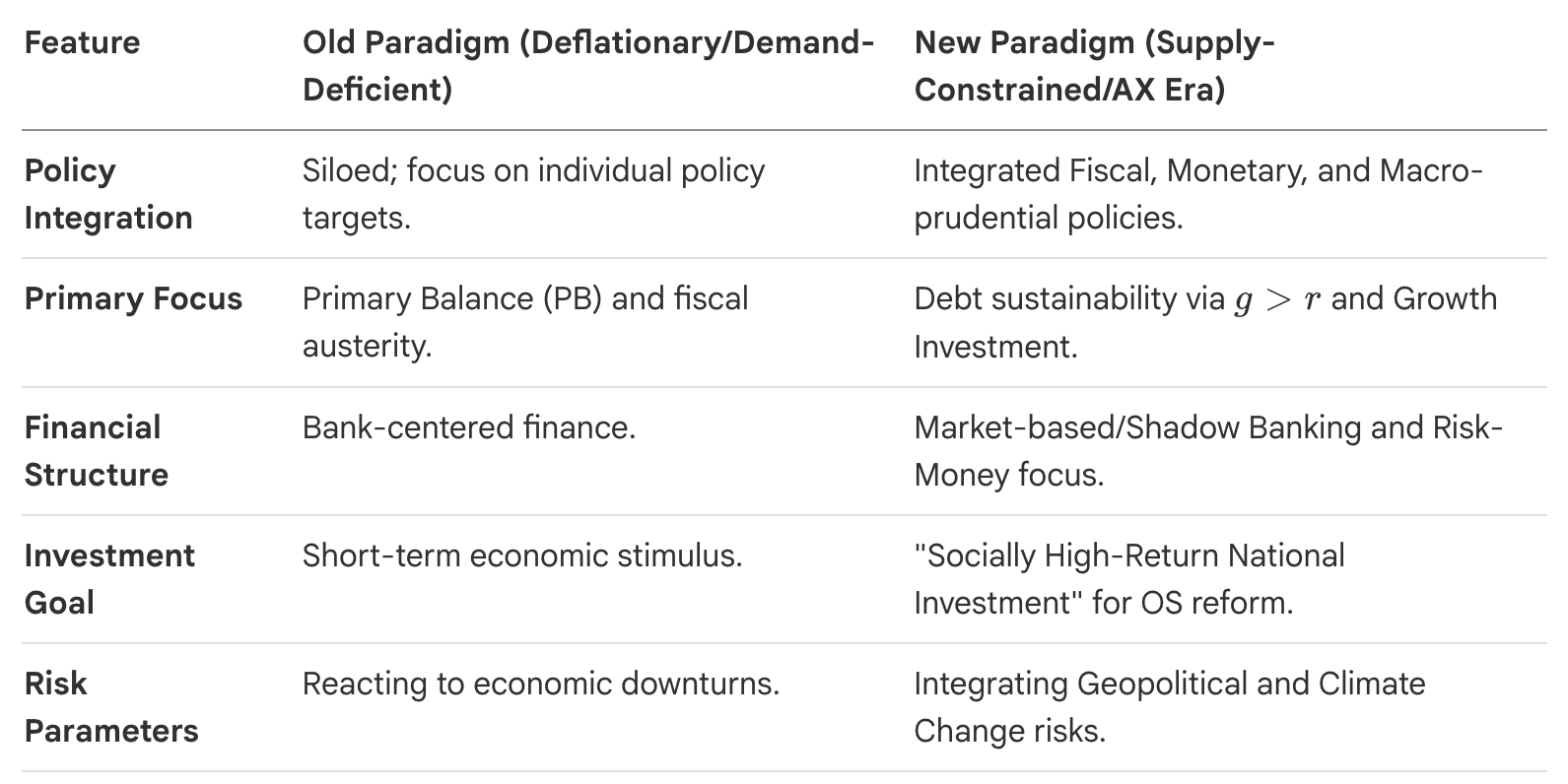
"Responsible Active Fiscal Policy" acts as a vital signal to the private sector. By the state taking the lead in "Crisis Management" and "Growth" investments, it de-risks long-term capital commitments in volatile sectors like semiconductors and energy, catalyzing the private sector's dormant animal spirits.
3. Strategic Realignment of Global Industrial Competitiveness
The era of a seamless international division of labor has been superseded by a restructuring of value chains along geopolitical lines. Japan must move toward "Global Value Chain (GVC) Reconstruction," aiming for "Autonomy and Indispensability" (自律性と不可欠性).
The Five "Winning Patterns" (Kachisuji)
To secure its national sovereignty, Japan must dominate the "Choke Points" of the global economy through five strategic archetypes:
- Global Scaler: Leveraging patient investment and M&A to dominate supply chains through sheer scale and price leadership.
- Domain Top: Dominating high-value-added niches by "formulating tacit knowledge" (暗黙知の形式知化) into unique data and branding that is impossible to imitate.
- Layer Master: Specializing in specific functional layers of production to become an "indispensable" component in the global industrial stack.
- Digital Industry: Mastering the choke points of Physical AI, creating platforms that integrate hardware with data-driven software.
- Resource/Energy: Securing stability through upstream interests and exporting "Strategic Packages" (O&M, standards, and technology) to the Global South to ensure long-term regional influence.
These patterns must be bridged by "Dual-use" (Defense-Economy) considerations. An "indispensable" Japan is one that secures production bases for technologies serving both civilian and national security needs (e.g., autonomous drones and sensors). This alignment ensures that industrial strength translates directly into national sovereignty.
4. AX (AI Transformation) as the Foundation for OS Reform
AI is the core "Operating System" for the new economy. "AX" (AI Transformation) is the primary driver for business model transformation, moving Japan from a manual-intensive economy to an automated, high-intelligence one.
Labor and Organizational Transformation
The integration of AX will fundamentally alter the structure of the Japanese firm:
- The "Intellectual Smile Curve": Japan faces a structural mismatch where traditional white-collar roles in Tokyo face surplus, while regional areas suffer acute shortages of the technical talent required for AI-robotics.
- Organizational Overhaul: AX enables an "explosion of back-office efficiency," shifting the role of middle management from administrative oversight to high-level value judgment. This creates a new synergy of "Boss power + Field power," where field-level expertise is amplified by AI-driven decision-making.
- Physical AI: Japan’s competitive advantage lies in merging software with its "Physical" strengths in manufacturing and healthcare, turning "tacit knowledge" into scalable digital assets.
AX allows Small and Medium-sized Enterprises (SMEs) to "Leapfrog" traditional digital adoption. Because SMEs are smaller and can be more top-down in their management, they can move directly to AI-driven autonomous operations, bypassing the slow, incremental stages of legacy DX.
5. Closing the Virtuous Cycle: The Consumption "Missing Piece"
Domestic investment and wage growth are the engines, but consumption is the "Missing Piece" that completes the virtuous cycle. In a supply-constrained world, Japan must activate consumption by increasing the "value" of human time.
Drivers of Consumption Vitality
- Real Wage Growth: Productivity gains from AX must be transferred directly to workers to sustain purchasing power against supply-side inflation.
- Disposable Time: AX-driven efficiency creates "Disposable Time," which fuels new demand for high-value services and experiences.
- Essential Services (ES) Reform: Japan must transform labor-intensive roles into "Advanced Essential Services." This shift will create the "Blue-collar Billionaire"—high-margin, high-status regional roles where AI handles the drudgery, and humans provide the high-value physical execution.
Public and municipal supply of essential services has reached its limit. Japan must foster "New Organizational Bodies"—market-based private-public hybrids—to deliver ES. Without this, the "low-productivity, low-wage" trap of the service sector will continue to drain the national economy, preventing the virtuous cycle from ever closing.
6. Strategic Conclusion: Toward 2040
The transition to a supply-constrained economy is Japan's greatest "Winning Chance." This strategy serves as the foundational Input for the Takaichi Cabinet's Growth Strategy, positioning Japan as the global leader in Physical AI and "Social Problem-Solving" growth. By redefining fiscal policy and industrializing Japan's solutions to labor shortages, the country will secure a future of autonomy and prosperity.
Strategic Checklist for 2040
- Transition 1: From PB-Focus to r < g Investment. Pivot fiscal policy toward Socially High-Return National Investments that aggressively resolve supply bottlenecks and de-risk private capital.
- Transition 2: From Human-Manual to AX-Centric Operations. Achieve a "Leapfrog" in SME productivity and create a new class of "Blue-collar Billionaires" through the nationwide implementation of Physical AI.
- Transition 3: From International Division of Labor to GVC Indispensability. Reconstruct value chains around "Dual-use" technologies and "Strategic Packages" for the Global South, ensuring Japan holds the "Choke Points" of the 2040 economy.
 Norbert Gehrke