The Rebalancing Act: Deconstructing Japan’s Evolving Multi-Trillion Dollar Stake in U.S. Debt

For decades, Japan has served as the preeminent cornerstone creditor to the United States, providing a critical stream of capital for American liabilities. However, this relationship is evolving at a precarious juncture for the U.S. external position. By the end of 2025, the U.S. net international investment position (NIIP) has deteriorated beyond -70% of GDP. This erosion is compounded by the elimination of the surplus in the investment income balance and a fiscal trajectory that remains highly expansionary. In an era where the U.S. relies on net foreign borrowing to finance its current account, the stability and motivations of its largest creditors are matters of sovereign strategic importance. In this blog post, we analyze the recent Brookings paper "The United States and its Creditors: Assessing Foreign Demand for U.S. Assets" from the Japan perspective.
The core thesis of the transformation described above is evidenced by profound structural change within the "Advanced Asia" bloc. While Japan remains a dominant creditor, the nature of its holdings is shifting from a monolithic block of official central bank reserves toward a complex web of private institutional investment. This transition from public to private hands fundamentally alters the sensitivity of Japanese demand to market shocks and geopolitical frictions. Understanding the future of U.S. funding costs requires a granular analysis of how Japan’s ownership of U.S. Treasury securities is being remapped across the globe.
1. The Shrinking Footprint: Japan’s Declining Share of the U.S. Treasury Market
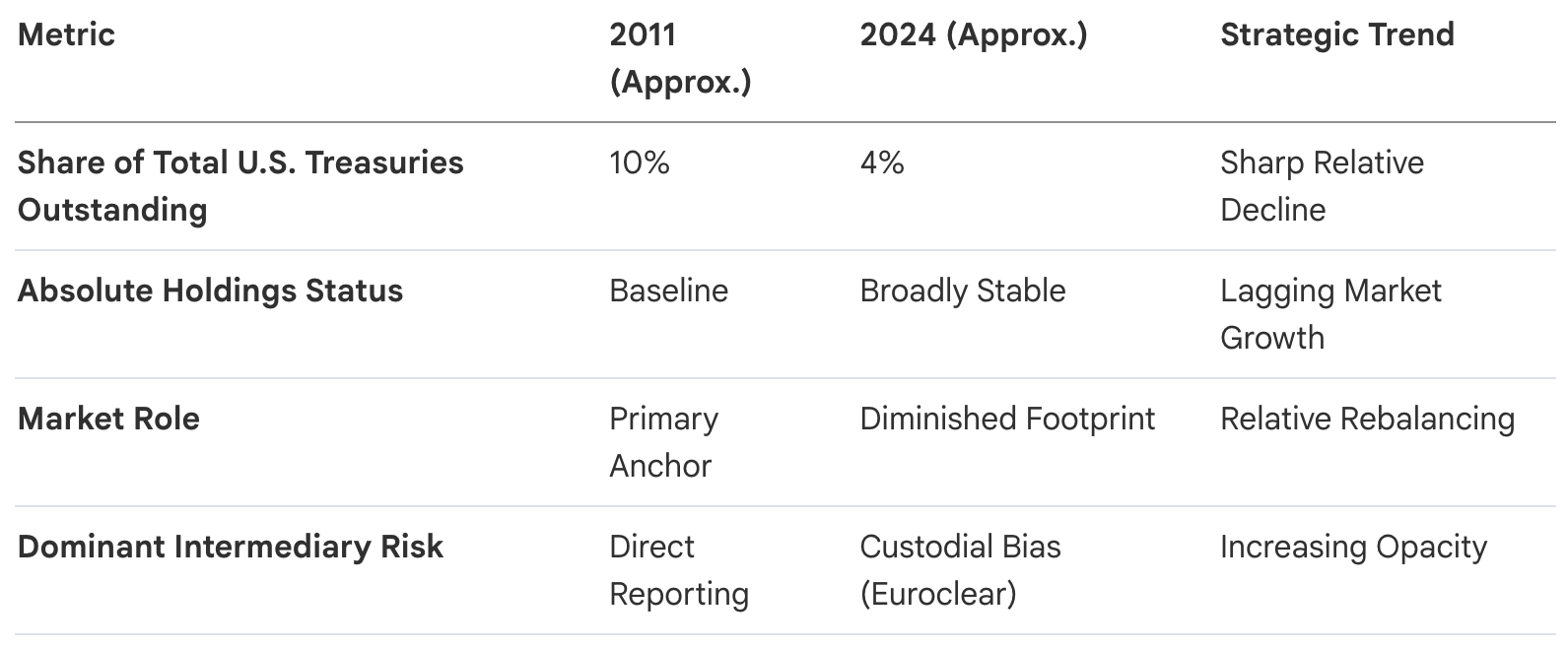
In evaluating Japan’s influence on U.S. funding costs, absolute holdings are a deceptive metric. The "share of total debt" is the critical barometer for measuring market influence. Between 2011 and 2024, the total market value of U.S. Treasury securities outstanding surged by approximately $15.6 trillion. While Japanese holdings remained broadly stable in absolute terms, their relative footprint was decimated. Japan’s failure to keep pace with the explosion of U.S. debt issuance reduces its role as a primary market anchor.
This decline is further complicated by "custodial bias." While official data shows Japan’s share falling from 10% in 2011 to roughly 4% in 2024, the rise of "Unknown" counterparts in residence-based statistics—often proxies for Asian reserves routed through Euroclear in Belgium—suggests that transparency is being sacrificed for strategic opacity. This "Belgian" routing often masks the true scale of Asian official reserves, though it does not negate the broader trend of a diminishing Japanese share.
2. The Compositional Pivot: Official Reserves vs. Private Institutional Demand
Japan is increasingly characterized as an "Official-Private Hybrid" holder. This distinction is vital; official reserve managers prioritize safety and liquidity, whereas private institutional investors—pension funds and insurance companies—are driven by yield and portfolio mandates. The perceived stability of Japan’s Treasury stake masks a perfect $200 billion offset: a $200 billion decline in official reserves held in securities was neutralized by a $200 billion rise in private-sector exposure.
From a nationality-based perspective, the complexity of this shift is staggering. As of 2023, Japanese investors held over $650 billion in Cayman Islands fund shares. This shift toward private and offshore intermediation introduces significant "leverage risk." Unlike central banks, private and leveraged investors (such as Cayman-based hedge funds) are acutely sensitive to funding conditions and margin calls. We saw a prelude to this in the volatility of March 2020, where forced deleveraging triggered rapid unwinding of Treasury positions. The rise of the "Unknown" origin category in adjusted data reflects a deliberate effort to avoid transparency, as official and private entities alike route assets through financial centers to obscure their strategies.
3. The Macro-Financial Engine: Currency Rebalancing and Yield Dynamics
The management of Japan’s sovereign debt portfolio is inextricably linked to the U.S. Dollar/Japanese Yen exchange rate. A documented "portfolio rebalancing" effect occurs when the U.S. Dollar strengthens against the Yen; Japanese official institutions often reduce their share of U.S. Treasuries to avoid currency over-exposure. This rebalancing acts as a mechanical stabilizer for Japanese portfolios but creates a headwind for Treasury demand during periods of Dollar strength.
Japanese demand is also subject to "crowding out" by the Federal Reserve. The "Fed share" of the Treasury market—the percentage of debt held by the U.S. central bank—mechanically reduces the available pool for foreign official buyers. Analysis shows a clear negative correlation: as the Fed absorbs more supply, the share available for Japanese official demand retreats.
Key Macro-Financial Drivers of Japanese Official Demand
- REER (Real Effective Exchange Rate): Strong negative correlation; USD appreciation prompts Japanese rebalancing (selling).
- FX Reserves Ratio: Direct scaling variable; demand grows with the global stock of reserves.
- Fed Share: Mechanical crowding-out; high Fed ownership reduces the available foreign pool.
- Geopolitical Fragmentation Index (GFI): Rising fragmentation serves as a persistent dampener on official demand.
4. Risk Assessment: Geopolitical Fragmentation and Future Vulnerabilities
In the current environment, non-financial drivers are increasingly dominant. Japan’s investment decisions are now filtered through the lens of "geoeconomic fragmentation," measured by the Geopolitical Fragmentation Index (GFI) and the Ideal Point Distance (IPD). The IPD, which measures the absolute difference between "ideal points" in policy alignment (such as UN voting patterns), reveals that while Japan remains geopolitically aligned with the U.S., the broader fraying of global relations creates "opacity risk" through financial-center intermediaries.
The "Liberation Day" tariff announcements in April 2025 provided a seismic signal for U.S. policymakers. Traditionally, "risk-off" shocks triggered a stronger dollar and lower yields—a countercyclical stability that benefited U.S. debt. However, the April 2025 event saw the U.S. dollar weaken while yields rose, suggesting the U.S. is losing its "safe-haven" status. This fundamental break indicates that U.S. interest rates may no longer provide traditional stability during global crises.
As Japan rebalances, the implications for the U.S. are clear: a creditor base dominated by private, leveraged investors is inherently more volatile and sensitive to "risk-off" shocks or margin calls. Looking ahead, a strong recovery in Japanese official purchases is highly unlikely absent a renewed period of rapid reserve accumulation or a sizeable, sustained depreciation of the U.S. Dollar. The U.S. must now prepare for a future where its cornerstone creditor is more selective, more private, and more susceptible to the unwinding of leveraged trades in an increasingly fragmented world.
 Norbert Gehrke