How Japan’s "Japan Invest" LLCs are Re-Engineering the U.S. Industrial Backbone

The Japan Bank for International Cooperation (JBIC) has announced significant financial backing for three major industrial ventures in the United States as part of a bilateral Strategic Investment Initiative. These projects focus on developing a deep-water crude oil export terminal in Texas, establishing natural gas power facilities integrated with data centers, and launching an industrial synthetic diamond manufacturing plant. By providing loans and co-financing alongside private institutions, the bank aims to enhance supply chain resilience and bolster economic security for both Japan and the U.S. These investments are designed to ensure a stable energy supply, support advanced AI infrastructure, and provide critical materials for the semiconductor and automotive sectors. Ultimately, the initiatives foster economic growth while creating new opportunities for Japanese companies to provide essential technologies and equipment within the American market.
1. Overview of the Japan-U.S. Strategic Investment Initiative
The Japan Bank for International Cooperation (JBIC) has executed a landmark tranche of strategic capital deployments that are designed to operationalize a new era in trans-Pacific cooperation. These loan signings represent the "first batch" of projects under the Strategic Investment Initiative, a framework formalized by the Memorandum of Understanding (MOU) signed between the Governments of Japan and the United States in September 2025.
According to the Government of Japan, this initiative is anchored by a three-fold mission designed to secure long-term stability:
- Promotion of Mutual Benefit: Creating high-value synergies between Japanese and U.S. enterprises in the infrastructure and technology sectors.
- Enhancement of Economic Security: Fortifying critical supply chains to ensure the uninterrupted flow of energy and industrial materials.
- Promotion of Economic Growth: Catalyzing industrial competitiveness by investing in the foundational infrastructure of the digital and advanced manufacturing age.
This strategic alignment is propelled by a sophisticated financial architecture designed to maximize impact while optimizing risk across the public and private sectors.
2. The Financing Framework: Public-Private Synergy
The structural cornerstone of this initiative is the "Japan Invest" LLC model. Rather than relying on traditional sovereign lending, JBIC has provided direct equity investment to establish these specialized U.S.-based entities. This "skin in the game" approach allows JBIC to act as a catalyst, "crowding in" significant private-sector capital. By providing direct loans alongside these equity stakes, JBIC creates a robust foundation for co-financing, ensuring that large-scale industrial projects benefit from the dual advantages of state-backed stability and private-market efficiency.
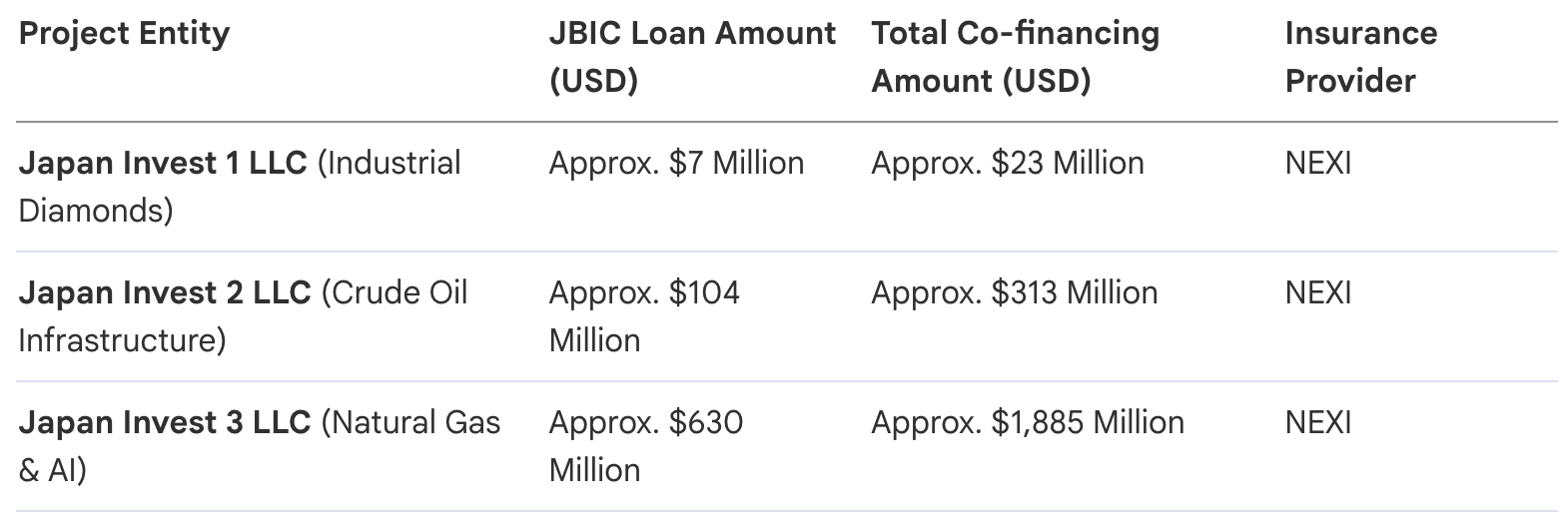
By combining JBIC’s equity and debt with private capital insured by Nippon Export and Investment Insurance (NEXI), the framework creates a "triple-layer" of security. This mitigates political and commercial volatility, providing the long-term capital commitment required to renovate the industrial foundations of the world’s two largest advanced economies.
With the financial architecture secured, the initiative directs its focus toward the dual imperatives of energy logistics and AI-ready power infrastructure.
3. Critical Infrastructure: Redefining Energy Export and AI Foundations
Strategic investment in U.S. energy and data infrastructure is now a prerequisite for a resilient Japan-U.S. supply chain. By modernizing how energy is transported and how power is generated for high-tech applications, the initiative ensures that the core inputs of modern industry remain both accessible and cost-effective.
The Crude Oil Transportation and Export Infrastructure Project, situated off the Texas coast, is designed to mitigate systemic logistical friction. By developing a deep-water terminal capable of directly berthing and loading Very Large Crude Carriers (VLCCs), the project bypasses existing bottlenecks. This development is critical as it addresses chronic port congestion, escalating logistics costs, and the environmental complexities of wastewater management that plague conventional transportation methods. The result is a more efficient conduit for U.S. crude oil to reach Japan and broader Asian markets, easing regional supply-demand pressures.
Parallel to this, the Natural Gas Generation Project represents a forward-looking integration of power and the digital economy. By developing natural gas generation and transmission facilities specifically linked to data center development, the project secures the essential power foundations for AI and advanced industries. Crucially, the "mutual benefit" of this project is already being realized: the Government of Japan has confirmed that Japanese companies have expressed significant interest in supplying the power generation and transmission facilities for these developments. This ensures that the digital backbone of the future is built upon a foundation of shared industrial technology.
While these large-scale energy projects provide the power for the modern era, the initiative also secures the specialized materials that serve as the high-tech coin of the industrial realm.
4. Advanced Materials: Securing the Synthetic Diamond Supply Chain
In the hierarchy of critical materials, industrial synthetic diamonds have become indispensable. Their physical properties are vital for high-precision manufacturing in sectors that define modern industrial sovereignty.
Under Japan Invest 1 LLC, the initiative is financing a manufacturing and sales project within the United States to secure a localized supply of these components. The synthetic diamonds produced are essential for:
- Automotive: High-precision machining of engine and chassis components.
- Aircraft: Production of advanced aerospace materials and structures.
- Semiconductors: Processing of the specialized materials that power the global electronics industry.
The strategic weight of this project was underscored during Japan-U.S. intergovernmental consultations, where it was confirmed that leading Japanese diamond tool manufacturers have already expressed interest in sourcing supply from this U.S.-based project. By localizing production, the initiative insulates Japanese industries operating in the U.S. from global disruptions, effectively strengthening the supply chain resilience of both nations through a targeted, diplomatic priority.
5. Strategic Implications for Global Supply Chain Resilience
The collective impact of these three projects signifies a fundamental shift toward proactive economic statecraft. By moving capital into energy logistics, AI-ready power, and critical materials, Japan and the U.S. are constructing a fortified economic corridor designed to withstand 21st-century shocks.
Key Takeaways
- Economic Security: The development of VLCC-capable terminals and localized critical material production reduces vulnerability to external supply shocks and logistical failures.
- Industrial Competitiveness: Integrating power generation with data centers provides the reliable infrastructure necessary for Japan and the U.S. to maintain a lead in AI and advanced manufacturing.
- Supply Source Diversification: By improving market access for U.S. crude oil and synthetic diamonds, Japan diversifies its sourcing, enhancing the overall stability of its industrial inputs.
 Norbert Gehrke