Travel Wallet Targets Global Scale with Japan Launch and Projected U.S. Expansion

Travel Wallet’s formal entry into the Japanese market takes the localized South Korean FinTech into the realm of a highly competitive environment against legacy banks over cross-border FX. By exporting its proprietary payment rails to Tokyo, the firm is signaling that its ambitions lie in becoming a foundational provider of global financial infrastructure. The move represents the first phase of an interoperable cross-border payment rail designed to bypass the frictional costs of traditional correspondent banking.
Market Analysis: Rationale for the Japanese Entry
Japan presents a unique set of macroeconomic conditions that make it ripe for FinTech disruption. Despite its status as a global financial powerhouse, the domestic market is characterized by a "low-digital, high-friction" environment regarding personal and commercial exchange. Travel Wallet is positioning itself to capture the volume from a market that has long been underserved by modern, low-spread FX solutions.
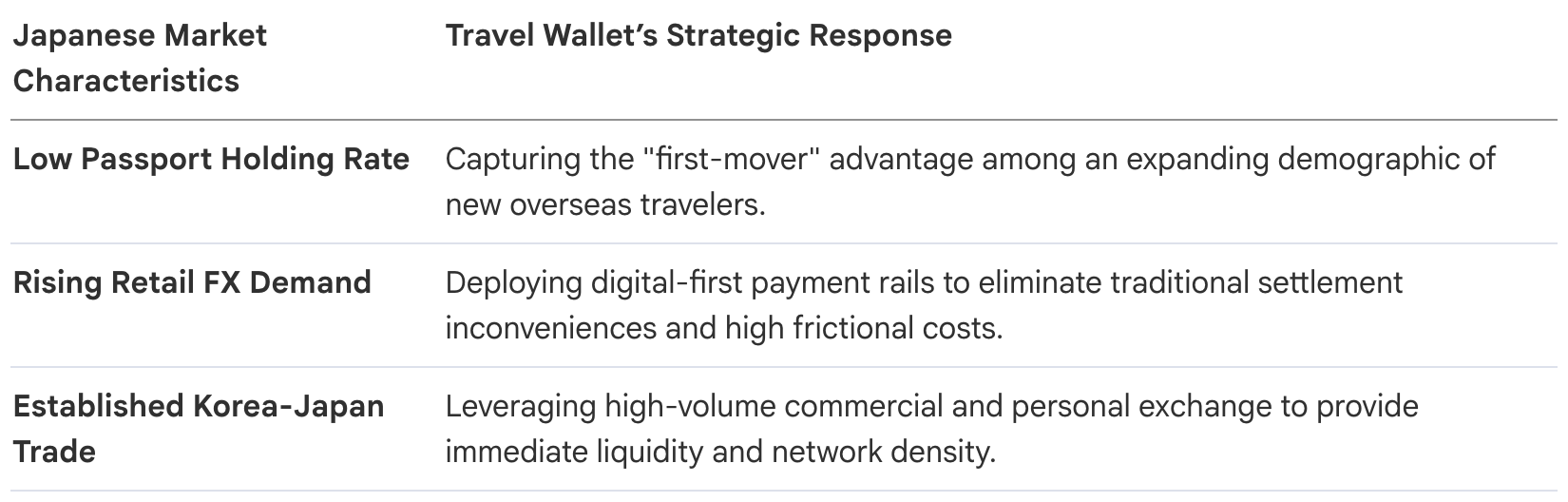
The primary growth lever identified by the firm is Japan’s historically low passport holding rate relative to other advanced economies. As post-pandemic overseas travel demand surges, a massive demographic of first-time or returning travelers is entering the market, seeking to avoid the high fees associated with legacy bank-issued cards. Furthermore, the existing high-density corridor of personal and commercial trade between South Korea and Japan provides an immediate, high-volume environment to stress-test and scale the platform’s B2B2C synergies.
This regional foothold is the critical first step in a pincer-style infrastructure play, with the Western anchor already in the company's sights.
Global Roadmap: The U.S. Expansion and Infrastructure Goals
The projected launch of Travel Wallet in the United States within the 2026 calendar year represents the second pillar of the company’s global architecture. By securing bases in both Japan and the U.S., Travel Wallet is positioning itself to internalize the spread on the North America-Asia corridor—one of the world’s most lucrative retail and commercial exchange routes. Controlling both ends of this corridor allows the firm to move beyond "app-based" services and into the role of a multinational digital wallet provider with its own internal settlement logic.
The company’s roadmap for building this unified global payment flow follows a tiered progression:
- Anchor: Utilize Japan and the U.S. as primary operational hubs for the Asian and North American markets, respectively.
- Scale: Broaden touchpoints with global users to increase the density and reliability of the proprietary payment network.
- Integrate: Expand cross-country infrastructure through phased regulatory and technical milestones to ensure seamless interoperability.
As these pillars stabilize, the company’s revenue focus will pivot toward the high-margin data and software integrations that define the modern fintech "moat."
Business Model Synergies: Data Acquisition and SaaS Integration
The true value proposition of Travel Wallet lies in the synergy between its consumer-facing wallet and its "financial cloud SaaS" for corporate clients. In this B2B2C model, the retail wallet acts as a sophisticated data ingestion engine. The granular transaction data harvested from millions of global travelers allows the company to model fraud detection, predict liquidity requirements, and optimize FX spreads with a level of accuracy that legacy institutions cannot match.
This integrated approach targets two high-value objectives:
- High-Margin B2B Revenue: Generating recurring, scalable income by licensing its financial cloud infrastructure to corporate clients who require secure, real-borderless payment solutions.
- Enhanced Security Moat: Utilizing global transaction data to harden the SaaS ecosystem against fraud while improving the precision of automated cross-border settlements.
By tethering consumer behavior to corporate utility, Travel Wallet is building a self-reinforcing ecosystem where data serves as the primary currency for technical superiority.
Executive Vision and Long-Term Outlook
The leadership's philosophy centers on the concept of a "single flow"—the total collapse of the traditional distinction between "sending" money (remittance) and "spending" money (payments). In the view of CEO Hyung-woo Kim, the future of global finance is not a series of disconnected hops through correspondent banks, but a single, proprietary ledger that facilitates the movement of value across borders in real-time.
Analyzing the strategy, CEO Hyung-woo Kim stated, "Starting with our entry into Japan, we aim to build a global payment infrastructure that connects remittances and payments between countries worldwide into a single flow." He further emphasized the commitment to "advance a multinational digital wallet service" that prioritizes user convenience by removing the technical barriers of the legacy financial system.
This vision of a "single flow" signifies a fundamental shift in the competitive landscape of foreign-exchange technology. As Travel Wallet successfully integrates its Japanese operations and prepares for its U.S. debut, it is moving closer to realizing a global utility model where cross-border transactions are as frictionless as domestic ones. Based on its current trajectory, Travel Wallet is evolving from a specialized tool into a vital architect of the next generation of global payment infrastructure.
 Norbert Gehrke