SBI Holdings Leads Strategic Round for Temple Digital

SBI Holdings is leading a private investment round for New York-based Temple Digital Group. This capital injection represents a vertical integration strategy designed to secure SBI’s leading position within the Canton Network ecosystem ahead of a major 2026 regulatory shift. By backing the network’s leader in network-generated revenue, SBI is becoming a primary stakeholder in the liquidity layer where institutional capital is increasingly concentrated.
For SBI Holdings, this investment represents a masterful stroke of "strategic moat building." SBI already occupies a privileged position as a founding partner and "Super Validator" of the Canton Network, giving it core oversight of transaction management. By securing a lead position in Temple Digital—the network’s premier electronic exchange—SBI has effectively achieved vertical integration. This dual role as both the underlying infrastructure validator and the owner of the primary commercial gateway creates a formidable strategic advantage, allowing SBI to capture value across the entire trade lifecycle while potentially raising questions regarding market concentration that are typical of traditional financial heavyweights.
1. Analyzing the "Lightspeed" Infrastructure and Market Position
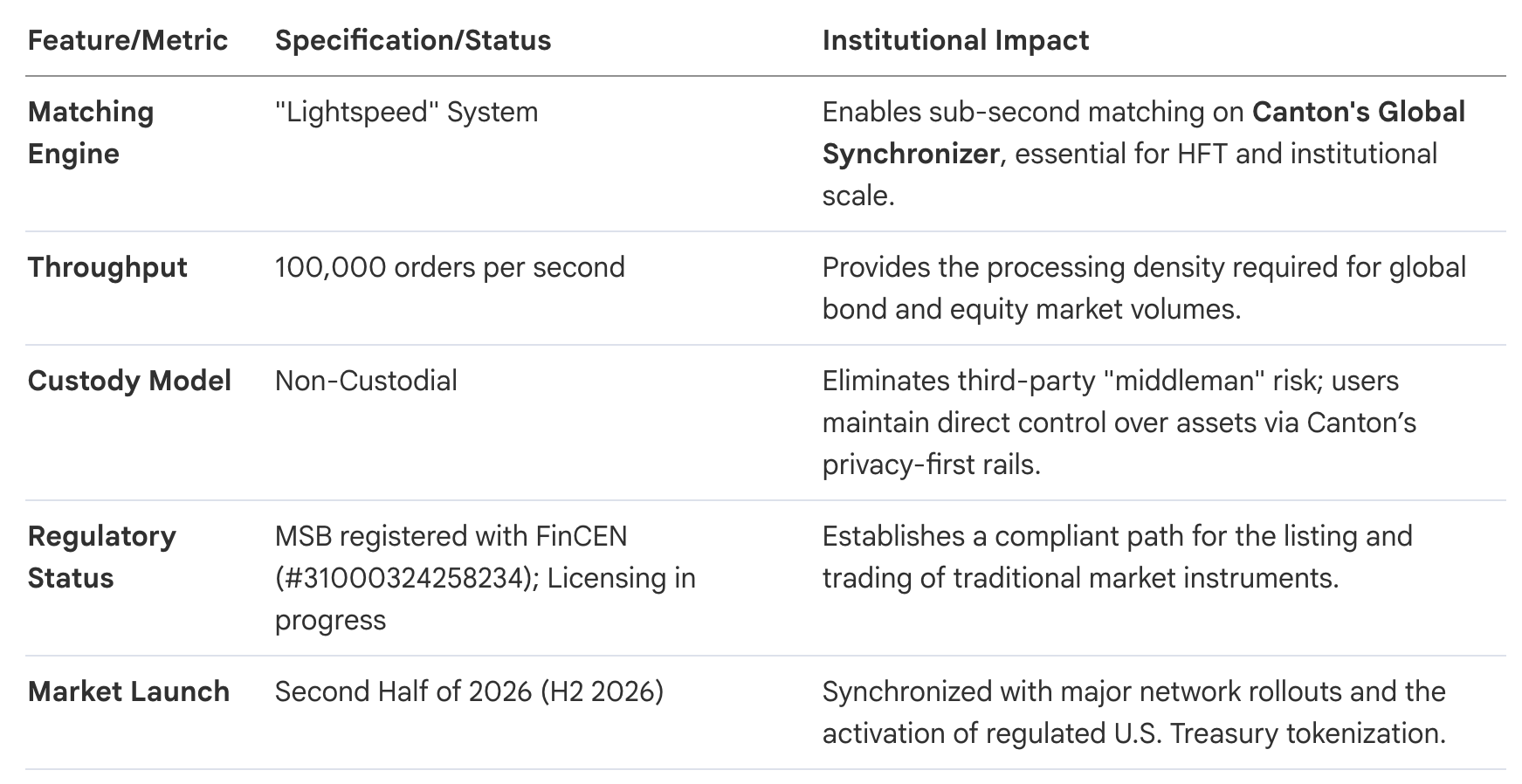
In the current institutional climate, high-performance trading infrastructure is the non-negotiable prerequisite for the migration of tokenized assets. For legacy players to abandon traditional electronic communication networks (ECNs), blockchain-native systems must deliver sub-second matching and massive throughput to manage capital efficiency without the latency drag typical of earlier decentralized iterations.
The Non-Custodial Advantage
Temple’s "non-custodial" architecture is a critical differentiator in a post-FTX era. By allowing institutional participants to manage their own assets while utilizing real-time settlement, Temple eliminates the insolvency risks associated with third-party intermediaries. This model preserves the privacy and composability of traditional market instruments while ensuring that sensitive trade data remains shielded—a mandatory requirement for any infrastructure aiming to replace legacy financial plumbing.
These technical capabilities serve as the engine for a network that is rapidly aggregating the world's most significant financial institutions.
2. The Canton Network: Scaling to a $6 Trillion Ecosystem
The Canton Network has emerged as the "institutional blockchain of choice," fundamentally because its design favors the interoperability required by regulated entities over the siloed nature of traditional finance. While legacy systems trap liquidity in disconnected ledgers, Canton allows for the seamless flow of assets across its participating institutions.
The "Network Gravity" is sustained by a Tier-1 roster of participants, including:
- Goldman Sachs
- BNP Paribas
- DTCC (The Depository Trust & Clearing Corporation)
- Franklin Templeton
- Broadridge
- Euroclear
The role of the DTCC is particularly catalytic. As the central clearinghouse for U.S. securities, its initiative to tokenize DTC-custodied U.S. Treasury securities on the Canton Network serves as the ultimate validation of the infrastructure. The Treasury market’s inherent volatility requires the precise, sub-second matching of Temple’s "Lightspeed" engine. Without such high-speed infrastructure, the tokenization of the world’s most liquid asset class would remain a theoretical exercise.
With over 600 participating institutions and $6 trillion in managed assets on-chain, the network has reached a density where cross-silo liquidity matching is no longer just possible—it is becoming the new standard. This environment provides the perfect backdrop for SBI’s broader global ambitions.
3. SBI’s Global Vision and the 2026 Regulatory Horizon
SBI Holdings is moving aggressively to leverage this environment for the launch of regulated, 24/7 tokenized equity trading in Japan and international markets. For a group serving over 50 million customers, the integration with Temple Digital provides the missing link between retail reach and institutional-grade exchange technology.
“There is a great deal of synergy between SBI and Temple - we both see the immense potential of Canton and how it will affect financial market infrastructure in the coming years. By joining forces we can bring our shared vision to life.” — Evan Varsamis, CEO and Co-Founder of Temple Digital Group.
“Temple stands out as the premier trading platform on Canton, its sub-second matching and privacy-first architecture deliver exactly the kind of institutional-grade infrastructure the ecosystem needs... we believe Temple is well positioned to become essential market infrastructure as tokenized assets scale across global capital markets.” — Juan Manuel Gomez, General Manager of SBI Holdings (International/US Division).
The 2026 Inflection Point
The second half of 2026 is coalescing into a pivotal window for the industry. This period marks the broader rollout of the DTCC’s Treasury tokenization and the expected finalization of Temple’s securities trading licenses.
In conclusion, SBI Holdings is effectively bridging its identity as a traditional financial heavyweight with its role as a pioneer in blockchain-integrated capital markets. By leading this round for Temple Digital, SBI ensures it is the operator of the very infrastructure that will define the next decade of global settlement and trading.
 Norbert Gehrke