The LDP's "Digital Japan 2026" Policy Proposal


For decades, the global financial community has viewed Japan’s digital landscape through a lens of "analog inertia." However, the fiscal implications of this digital friction have finally been priced into the nation’s demographic crisis over the past years, forcing a 21st century approach.
The "Digital Japan 2026" blueprint, presented today by the ruling party's Digital Society Promotion Headquarters, represents a thoughtful and comprehensive reconstruction of the Japanese state, the first steps of which had been taken with the establishment of the Digital Agency and its initial deliverables.
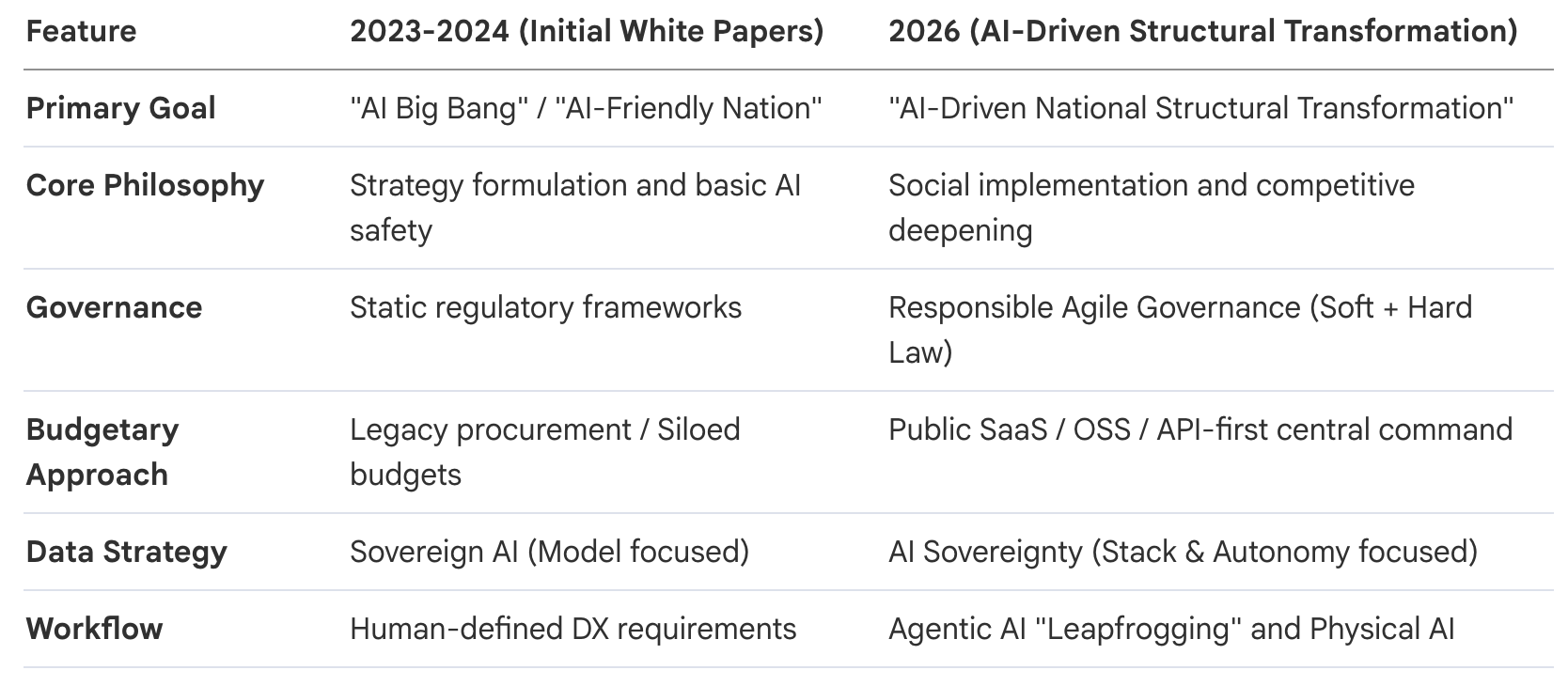
Under the mandate of "Responsible Agile Governance," the administration is shifting to a dynamic, learning-based model intended to survive the "Stage II" era of AI implementation. The strategic urgency is absolute: increasingly, Japan faces a choice of either structurally transitioning into an AI-driven state or accepting a permanent position as a "laps behind" consumer of foreign intelligence stacks.
The 2026 policy is anchored by five critical pillars, each designed to dismantle specific structural bottlenecks:
- "DX by AI" and Agentic Leapfrogging: The rejection of traditional Digital Transformation (DX) in favor of "Agentic AI" that autonomously defines workflows and writes code.
- By bypassing the multi-billion-dollar requirement for human-led Business Process Re-engineering (BPR), Japan aims to compress a decade of digital debt into a 24-month "leapfrog" cycle, drastically altering the ROI for domestic productivity.
- The "Digital Social Passport" (My Number Card): The mandatory evolution of the My Number Card into a default-usage identity layer for all public and private interactions.
- Achieving 100% integration (from 65.50% utilization of the insurance card as of February 2026) creates a 100-million-user digital identity moat, enabling "push-type" government transfers and eliminating the administrative friction that currently hampers capital flow.
- Responsible Agile Governance: A middle-path regulatory model that abandons "regulation vs. innovation" in favor of a real-time feedback loop.
- This creates a "safe-to-fail" sandbox environment for global tech firms, positioning Japan as the world's primary testbed for high-risk AI implementation under a "best mix" of hard and soft law.
- Strategic AI Sovereignty: Securing strategic autonomy in the AI stack, focusing on domestic power grids and sovereign data center resources.
- This shifts Japan from seeking a "Sovereign AI" (model ownership) to "AI Sovereignty" (structural indispensability), ensuring the nation is a core node in the global digital order.
- The Advanced Essential Worker: The deployment of Physical AI and robotics to augment labor in high-touch sectors like nursing and disaster prevention.
- This redefines the labor market value proposition, allowing human capital to be reallocated to "human-only" tasks, effectively neutralizing the productivity drain of an aging population.
1. The New Governance Paradigm: Moving Beyond "Regulation vs. Innovation"
The "Digital Japan 2026" blueprint identifies the traditional "Fixed Institutional Design" as the single greatest threat to Japanese competitiveness. In an era where Generative AI capabilities evolve weekly, legislative frameworks that take years to draft and decades to repeal are toxic to innovation. Consequently, the policy proposal has adopted "Responsible Agile Governance" as its middle-path model, positioned strategically between market-led laissez-faire and the precautionary, "ex-ante" regulation seen in other major jurisdictions.
"Digital Japan 2026" contrasts three distinct governance models to highlight this shift:
- Market-Led/Ex-Post Model: This "permissionless" approach prioritizes "destructive creation," allowing technologies to run ahead of the law. While it maximizes speed, it lacks the safety and ethical guardrails required for the 2026 "Social Implementation Stage," often resulting in catastrophic trust failures.
- Precautionary/Ex-Ante Model: Characterized by "Don't move until 100% safe," this model relies on comprehensive "Hard Law" and massive penalties. For an "Agile Nation," this approach is a death sentence, leading to a regulatory blockade that ensures Japan remains "周回遅れ" (laps behind) the global frontier.
- Responsible Agile Model: The definitive Japanese standard. It utilizes a continuous, learning-based loop: Demonstration → Risk Visualization → Rule Update → Knowledge Reflection. This model does not view risk as a reason to inhibit challenge, nor does it allow for disordered introduction. Instead, it reflects on-the-ground wisdom into institutional design in real-time.
To facilitate this, Japan is deploying a "Best Mix" of legal tools:
- Hard Law (Legal Stability): Robust, fixed foundations for safety, reliability, and fundamental rights. These are the "堅牢性" (robustness) pillars of the state.
- Soft Law (Flexible Guidelines): Guidelines, standards, and industry best practices that adapt to technical shifts. By using soft law as a "technical follower," the government can iterate on safety requirements without waiting for parliamentary sessions.
The strategic goal is to utilize "Regulatory Sandboxes" to gather data, then use that data to refine both hard and soft law. This ensures that the nation’s "Governance Platform" evolves at the same velocity as the AI it oversees.
2. DX by AI: From Manual Automation to Agentic Autonomy
Market observers have long noted the "cost-performance wall" of traditional Digital Transformation in Japan. Historically, DX was a labor-intensive process where humans defined every requirement, wrote every line of code, and manually mapped every workflow. This high cost meant that only the most profitable sectors were digitized, leaving a massive "analogue swamp" in public services and SMEs.
The 2026 blueprint marks the end of this era. Generative AI has fundamentally altered the economics of automation. Under the mandate of "DX by AI," Japan is abandoning the requirement for human-led BPR. Instead, it is adopting three specific AI layers to "Leapfrog" traditional DX steps:
- Agentic AI: Autonomous agents that can read human-language manuals, define their own workflows, and write the necessary integration code. For the first time, "messy" legacy systems are no longer a barrier; the AI simply navigates the mess.
- Vertical AI: Industry-specific models that integrate "Genba-chi" (field-level wisdom) and specific regulatory rules to create high-moat competitive advantages in manufacturing, construction, and healthcare.
- Physical AI: The integration of digital intelligence into robotics, allowing AI to "extend its arms" into the physical world. This is the cornerstone of the "i-Construction 2.0" and logistics initiatives.
A central pillar of this transformation is the creation of the "Advanced Essential Worker." The 2026 policy explicitly rejects the "replacement" narrative. In sectors like nursing and welfare, AI and Physical AI are intended to automate routine administrative and physical labor. This frees the "Advanced Essential Worker" to focus on high-value human empathy and complex, creative decision-making—tasks that remain the "human-only" domain. The productivity gain here is twofold: it preserves the dignity of the labor force while drastically reducing the fiscal burden of the labor shortage.
3. The "Passport" to a Digital Society: Radical My Number Card Integration
The My Number Card has reached a critical 100-million-card milestone, but the 2026 report argues that "voluntary" adoption is a ceiling that must be shattered. To unlock the full value of the digital society, the government is transitioning the card from an "option" to the "Digital Social Passport." This is the foundational identity layer required for all "push-type" public services.
The strategic mandates for this transition are uncompromising:
- Penalty-Free Mandatory Acquisition: The government is actively investigating the legal necessity of making card acquisition mandatory. The goal is to ensure 100% population coverage so that the state can design administrative systems around the assumption of digital presence, rather than maintaining dual analog/digital tracks.
- Default Usage Systems: Administrative services are being redesigned with the card as the default. This includes the digitalization of all national qualifications, the mobile integration of driver's licenses, and the 100% integration of medical insurance cards.
- The "New Scenery" of Public Services:
- One-Stop Service & Serial Information Linkage: Current systems require users to re-authenticate at every step (e.g., e-Tax vs. private insurers). The 2026 blueprint mandates a "シリアル情報" (serial information) linkage across ministries and the private sector, allowing a single authentication via the "Myna App" to complete a complex chain of administrative actions.
- Push-Type Financial Support: Shifting from "application-based" to "push-type" aid. Using registered public payment accounts, the state can deliver targeted support—via points, cash, or ATM withdrawals—instantly in response to inflation or disasters.
- The 65.50% Milestone: As of February 2026, medical insurance card utilization stands at 65.50%. The administration is aggressively pushing toward 100% to realize the "Medical DX" foundation required for advanced health-tech implementation.
4. Business and Administrative DX: Building the G-Biz Ecosystem
To revitalize national productivity, the 2026 blueprint prioritizes the eradication of "analogue bottlenecks" in Business-to-Government (B2G) interactions. The objective is a "frictionless" business environment where the state functions as a service provider via the G-Biz Ecosystem.
The upgrade requirements for this ecosystem are granular:
- G-Biz ID & Base Registries: The current "update lag" is being eliminated. The G-Biz ID system will be integrated with Base Registries (Corporate, Real Estate). When a company registers an officer change at the Legal Affairs Bureau, the G-Biz ID will update in real-time, instantly reflecting that change across all B2G portals. This is vital for the JESTA foreigner policy (to be introduced by FY2028), ensuring that foreign property and business owners can manage assets with international-standard transparency.
- J-Grants (Mandatory Usage): The policy mandates that all subsidies containing national funds—even those funneled through local governments—must use J-Grants. This allows a company’s AI to search and draft grant applications automatically based on the company's financial data.
- G-Biz Portal & Electronic Locker: This is the most radical shift. The "Electronic Locker" is a shared web folder where businesses and the state collaborate. Crucially, the policy notes that "BPR is no longer a prerequisite" for digitalization here. Because the new "Government AI Gennai" can handle legacy Word and Excel formats, the state is giving up on cleaning data and letting AI handle the "messy" files. A CEO can now issue a voice command in Japanese to "analyze the locker documents and draft a new food bank application," with the AI executing the "Tetsuzuki Journey" (Procedure Journey) across multiple ministries.
5. Sectoral Deep Dives: Disaster Prevention, Finance, and Infrastructure
The "Agile Nation" vision is being stress-tested in three "maximal social implementation" domains where the stakes of failure are life and death, or the collapse of capital markets.
Disaster DX: The "Zero Related Deaths" Mandate
The Disaster DX PT proposal targets "Zero Disaster-Related Deaths" by shifting from "Place-based Support" (supporting a shelter) to "Human-centered Support" (tracking individual needs via the My Number layer).
- Phase-free DX: This concept eliminates the distinction between "ordinary" and "emergency" times. Digital systems used for daily healthcare become the tracking system during a quake.
- Digital Twin Simulations: Real-time integration of drones, satellites, and AI to simulate damage and direct autonomous logistics in a "decentralized disaster data space."
On-chain Finance and Capital Markets
The "Next Generation AI/On-chain Finance 構想 PT" is redesigning the plumbing of Japan’s financial sector. By integrating AI with blockchain-based financial systems, the government aims to modernize capital markets, facilitating real-time settlement and AI-driven compliance. This is coupled with "AI for Science," which utilizes automated experimentation to revitalize Japan’s research capacity, positioning the nation as a leader in deep-tech IP generation.
AI for Mobility and Defense
These sectors are designated as the primary domains for achieving "dead-stop" level safety. The focus is on AI-integrated infrastructure—such as smart roads and autonomous defense grids—that can make sub-second decisions to prevent loss of life.
6. Institutional Architecture: The "Digital Agency 2.5" Reform
To act as the "Command Tower" (Sashireitou) for this transition, the administration is undergoing a fundamental restructuring into "Digital Agency 2.5." This reform addresses the "Digital Slump" data: as of late 2025, 25.9% of specific transition support systems and 52.3% of local governments were identified as failing to meet initial deadlines.
The Digital Agency 2.5 response includes:
- Centralized AI Integration: The "Government AI Gennai" environment will be merged into the heart of all government operations. Gennai is designed to handle the most "avoided" tasks—such as Diet (parliament) responses and travel procurement—to prevent a brain drain of young civil servants and prove the efficacy of AI first-hand.
- Budget & Procurement Overhaul: Moving away from siloed legacy procurement toward Public SaaS and Open Source Software (OSS). The agency will prioritize "API-first" development to ensure national and local networks are commonized by 2030 via the GSS (Government Solution Service) and LGWAN.
- AI Sovereignty vs. Sovereign AI: The policy makes a sharp distinction. Japan is not merely interested in owning a large language model; it is interested in AI Sovereignty. This requires a strategic grip on the power grid and data center infrastructure. The goal is "strategic indispensability"—ensuring the global AI stack cannot function without Japanese nodes.
7. The Human Element: Reforming Skills, Education, and the Labor Market
The 2026 blueprint acknowledges that technological prowess is useless without social acceptance. This requires a "Three-way Trust Design":
- Law: Agile regulatory frameworks.
- Technology: Audit capabilities and technical control mechanisms.
- Literacy: A massive update to user literacy and professional education.
The Digital Talent Skill Platform (from the Digital Infrastructure Subcommittee) is the engine for this social update. The core shift is from "Academic Background" to "Learning History" (Micro-credentials).
- Micro-credentials: Granular certification of specific AI skills, allowing for rapid labor mobility.
- Job Tags & Labor Connection: Skill definitions are being connected directly to "Job Tags" in the labor market. This supports the transition from "Membership-type" to "Job-type" employment, where workers are hired for specific skills rather than general corporate loyalty.
- Large-scale Reskilling: The state will subsidize massive reskilling programs to transition legacy workers into "Advanced Essential Worker" roles, ensuring that the digital divide does not become a permanent social chasm.
8. Conclusion: Japan’s Global Proposition as an "Agile Nation"
The "Digital Japan 2026" vision is Japan’s final answer to the digital age. By embracing the "Responsible Agile Governance" model, Japan is offering the world a new standard: a state that is as dynamic as the technology it regulates. This blueprint argues that in the AI era, the only way to protect democratic values—freedom, safety, and ethics—is to build a government that learns, iterates, and evolves in real-time.
Whether Japan can break through the final 52.3% of local government inertia remains the primary risk. However, the legislative and technical foundations are now in place. The structural transition to an AI-driven state is no longer a matter of "if," but of how quickly the nation can pivot. In the global race for AI sovereignty, Japan has bet its future on agility, betting that a "learning nation" will inevitably outpace a "regulating nation."
 Norbert Gehrke