The Pachinko Playbook: How Japan’s Tech Startups are Gamifying the Future in a Gambling Gray Zone


Global prediction markets are currently witnessing an unprecedented explosion in liquidity, with industry frontrunners Polymarket and Kalshi reporting transaction volumes that have eclipsed $130 billion this year—a dramatic surge from $50 billion in the previous period. Conversely, Japan’s rigid anti-gambling framework, underpinned by a Penal Code that punishes habitual gambling with up to three years in prison, has long relegated the domestic market to a "no-go zone." In response, a cohort of Gen Z entrepreneurs is executing a strategy of regulatory arbitrage, deploying "point-based" models to circumvent these barriers. By facilitating wagers through non-monetary virtual tokens rather than yen, platforms like Mirai-ma are successfully porting the logic of event-based trading into a legally defensible digital environment.
The ascent of this sector is catalyzed by three critical drivers:
- Cultural Habituation: The strategic repurposing of "poi-katsu" (point activities), a deeply rooted Japanese consumer habit, to replace traditional cash-based risk.
- Demographic Shift: High market penetration among men in their 20s who seek gamified, mobile-first interactions with news, sports, and finance.
- Legal Arbitrage: The utilization of indirect payout structures that distance the act of wagering from the direct exchange of currency, mirroring the mechanics of the legacy pachinko industry.
This shift signals a deeper digitization of Japan’s informal economy, anchored by a ubiquitous consumer behavior known as "poi-katsu."
1. The "Poi-Katsu" Pivot: Mechanics of the Point-Based Prediction Model
The operational success of these startups relies on "poi-katsu" (point activities), a cultural phenomenon where Japanese consumers gamify daily tasks and shopping to accumulate rewards. Startups have effectively digitized the "pachinko-style" workaround: just as physical parlors award tokens that are exchanged for cash at a separate, third-party business, digital prediction apps award points redeemable through external providers. By maintaining this indirect structure, platforms attempt to remain outside the strict definitions of "cash gambling" that would otherwise trigger criminal prosecution.
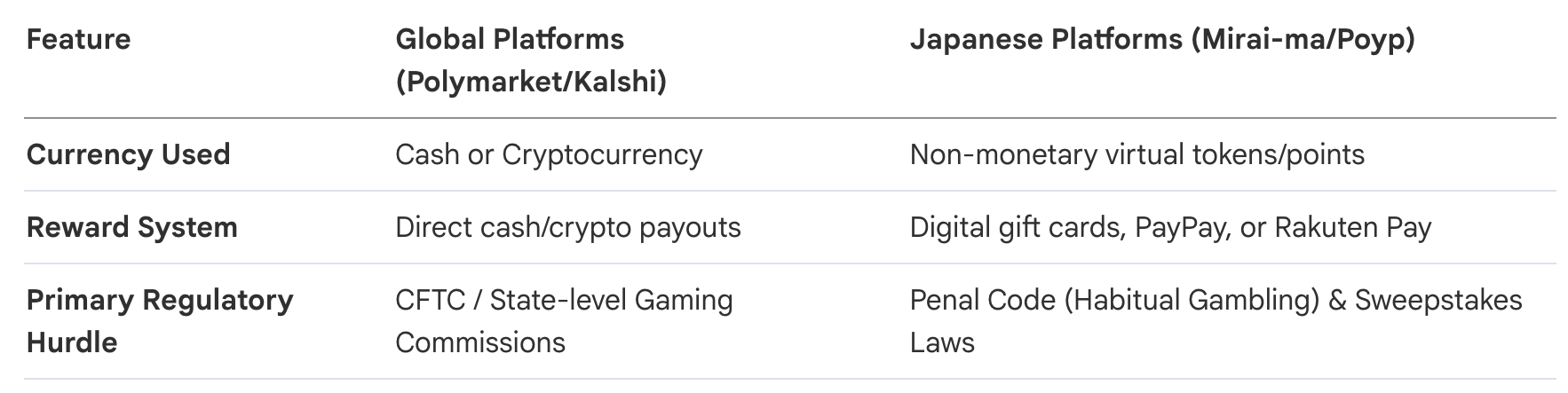
The user journey on Mirai-ma is engineered to be frictionless. Users accumulate an initial stake by opening accounts, viewing advertisements, or engaging with in-app games. Once a wager is won, the points can be utilized for further predictions or immediately converted into digital rewards, such as Amazon gift cards. Crucially, these points can be funneled into major easy-payment ecosystems like PayPay and Rakuten Pay, allowing the rewards to function with the liquidity of cash without the direct legal classification of "winnings." This frictionless architecture has catalyzed explosive adoption among digital natives, particularly during a high-stakes political season.
2. Demographic Momentum: Gen Z and the February Election Catalyst
The momentum behind Japan’s prediction markets is concentrated heavily among men in their 20s, a demographic that increasingly favors mobile-first experiences over the physical arcade and pachinko environments of previous generations. High-stakes political events have acted as a market stress test, transforming complex civic processes into what has become a "national guessing game."
The February House of Representatives election served as a watershed moment. Platform engagement spiked as users wagered on district outcomes, many galvanized by the rise of Prime Minister Sanae Takaichi. Takaichi’s assertive focus on national strength and economic security resonated with young male voters, who used platforms like Mirai-ma to track and monetize her political momentum.
The habit-forming nature of this gamified interface is evidenced by user behavior. Ryoga Kamei, an IT engineer in his 20s, highlights the "compulsive appeal" of the model:
"It's a bit addictive... I find myself opening the apps whenever I have a spare moment, or when there’s news that might move the odds."
Kamei reports earning over ¥10,000 a month through these apps, illustrating how a new generation is successfully monetizing its consumption of real-time information. This demographic momentum has transformed the sector from a niche experiment into a crowded battlefield for both startups and established gaming conglomerates.
3. Competitive Landscape: From Startups to Gaming Giants
The rapid validation of the point-based model has ignited a race for first-mover advantage between agile startups and established corporate entities. As the sector matures, the entry of traditional mobile gaming giants suggests that event-based trading is being viewed as a long-term strategic growth sector.
- Mirai-ma (Developed by Masentic): Launched Nov 2025. Currently Japan's largest platform with approximately 1 million monthly active users. Founded by Keita Adachi with backing from soccer star Keisuke Honda.
- Poyp: Launched March 2026 by founder Takanori Shirasaka. Positioned as a direct competitor; Shirasaka is currently active in lobbying efforts to achieve market legitimacy.
- Gumi: Entered the market in June 2026. As a traditional mobile game developer, its entry signals a move by established gaming firms to capture the prediction market trend.
Domestic operators face "razor-thin" margins compared to their global counterparts. While crypto-based global operators generate millions of dollars through transaction and settlement fees, Japanese apps rely on advertisement commissions and download fees. According to Keita Adachi, this lower-margin model is the necessary cost of maintaining regulatory compliance within Japan’s gray zone. While domestic founders harbor ambitions to transition to real-money markets, they currently prioritize the "defensible" point-based structure. While domestic players navigate these thin-margin compliance hurdles, they now face the looming entry of international heavyweights eyeing the post-2030 landscape.
4. The Regulatory Gray Zone and Legal Forecast
Regulatory clarity remains the primary variable for the long-term viability of event-based trading in Japan. To curb illegal gambling, the government has historically restricted the industry to pachinko, local lotteries, and state-controlled operations including horse racing, boat racing, and bicycle racing. While Poyp founder Takanori Shirasaka argues that the lack of "assets with actual value" at risk places these apps outside gambling laws, institutional leaders are sounding the alarm.
Hiromi Yamaji, CEO of Japan Exchange Group, has cautioned that betting on future events is "broadly seen as gambling." Beyond the legal definitions, Yamaji specifically cited the threat to market integrity, noting that monitoring and identifying insider trading remains a significant challenge for unregulated event-based platforms. The pachinko market, which exceeded $100 billion according to the latest available market data—a size larger than the gambling markets of Las Vegas and Macau combined—already gives the government a significant regulatory headache.
Further complicating the outlook is the absence of age restrictions on domestic point-based apps. While global leaders like Polymarket enforce strict 18+ limits, Japanese services currently allow minors to participate. According to Shinichiro Mori of Mori & Partners, the presence of minors significantly increases the likelihood of a government crackdown. As the legal battle lines are drawn, the ultimate litmus test for the industry will be the 2030 horizon.
5. Conclusion: The Path to 2030 and Beyond
The year 2030, which will see the opening of the MGM Osaka casino resort, is increasingly viewed as the critical inflection point for Japan's wagering industry. International heavyweights are already positioning themselves for this shift; Polymarket recently appointed Mike Eidlin, the former head of Jupiter Japan, to lead its local efforts and spearhead a lobbying campaign for government approval.
Ultimately, the surge in point-based markets represents a fundamental shift in how the Japanese public interacts with risk and information. Whether the "pachinko playbook" serves as a permanent workaround or a stepping stone toward a fully regulated, real-money prediction industry remains to be seen. However, as digital points increasingly function with the utility of cash, Japan’s regulators may soon find that the "gray zone" has become too large to ignore.
 Norbert Gehrke